
Did the Roman Empire Actually Fall or Just Shapeshift Into the Church?
What if the greatest act of psychological control in human history wasn't a war, a law, or a conquest... but a story?
Nearly a year ago, I was on a routine walk around my neighborhood, which is something I do daily. However, on this particular day, I decided to explore a different path.
It didn’t take long to realize why I was drawn down a different route.
I came across a little book nook on the corner. You know the ones… those small wooden boxes people fill with secondhand books. They’re sprinkled all over the neighborhood, which is one of the many things I love about this place.
I always stop to take a glance at what treasures are nestled inside, whether for a quick bibliomancy message or a more committed journey I never saw coming, and sitting there among the paperbacks was a thick, heavy book with bold lettering on the spine:
Holy Blood, Holy Grail.
Obviously, I picked it up.
If you follow my work, then you know I have an affinity for the stories of Yeshua and Mary Magdalene. You may also know that I’m Lebanese, and at the time, I was weeks away from returning to Lebanon for the first time in six years. A trip back to the place that birthed me, the culture that shaped me, the country I’ve witnessed experience bloodbath after bloodbath due to religion.
Something about that book felt like it was waiting for me, so I took it home.
That was over six months ago. And I have been time traveling ever since.
I want to be upfront with you—Holy Blood, Holy Grail is a controversial book. It’s speculative and some have even proclaimed it’s a hoax (which only makes me that much more intrigued). The authors—Michael Baigent, Richard Leigh, and Henry Lincoln, who have all passed away, and I know that because I wanted to email them (lol)—are asking questions, not necessarily delivering verdicts, and mainstream historians take issue with some of their conclusions.
But here’s what I’ve come to believe about really good books… sometimes their greatest gift isn’t the answers they give you. It’s the questions they refuse to let you ignore.
This book has left me with more questions than answers, and I have yet to reach the final page (it’s quite dense).
However, as I near the last remaining pages of what has become the focal point of the last six months, the question at the center of all of it is this…
What if everything we were taught about religion—the beliefs that have shaped civilizations, started wars, divided families, and told us who we are and whether we’re worthy—was, at least in part, a carefully constructed political project?
Not divine revelation. Not timeless truth handed down from above. A strategy. Designed by men in power, to keep men in power.
This may not be breaking news to some of you, as many of us have challenged the inception of religion and its ties to politics and world history. Yet, something feels incredibly poignant to this point in time.
As I was preparing my Lebanese tartine and iced latte for breakfast recently, I was hit with a That’s So Raven moment…
Remember when TikTok had that trend of women asking their husbands or the men in their lives how often they think about the fall of the Roman empire? That was a clue. And for a long time, I thought it was foreshadowing the fall of the American empire (which is part of the equation), but this morning, it dawned on me…
The Roman empire never actually fell, but perhaps it’s about to.
So, let’s go back to Rome.
when christianity became a chess piece.
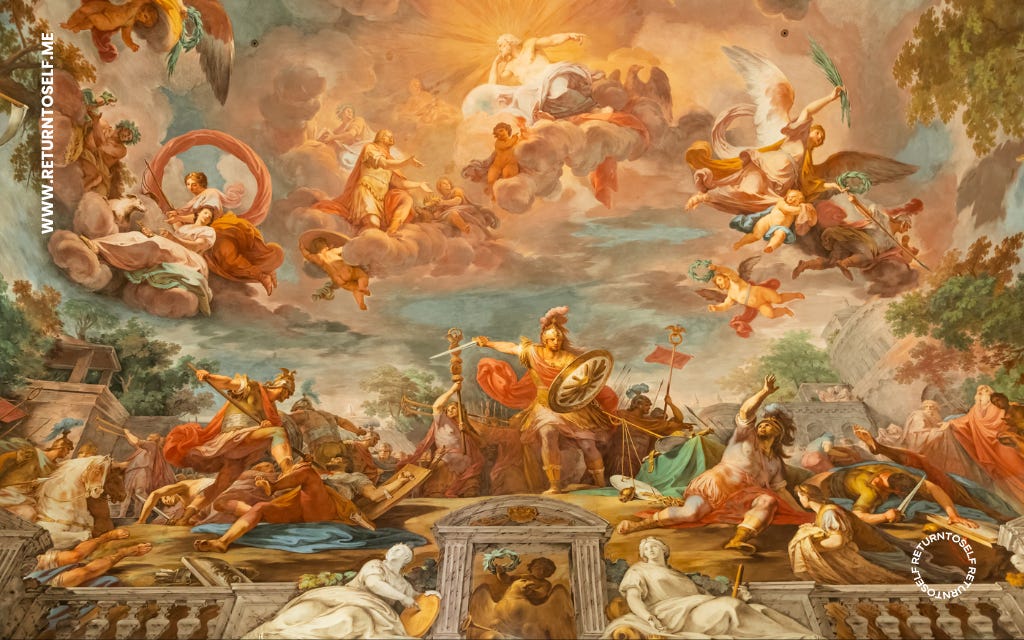
By the early 4th century, the Roman Empire had a problem. It was vast, expensive, and fracturing at the edges. The old civic religion—devotion to Jupiter, the Emperor as divine figurehead—was losing its hold on people. And a new movement was spreading with a speed that no amount of persecution could stop: Christianity.
Many tried to crush it, but it kept growing, because it offered something the imperial cult never could. An interior life. Personal relationship with the sacred. Community. Meaning.
So Emperor Constantine did something far smarter than persecution.
In 313 AD, he extended official tolerance to Christians through the Edict of Milan. And then, in 325 AD, he convened the Council of Nicaea.
Nicaea was not primarily a spiritual gathering. It was a policy meeting. Constantine presided over it as Emperor, not as a theologian. The council’s central task was to decide which version of Christianity would become official—meaning which version would be governable, scalable, and useful to the Roman state.
Entire gospels were debated and excluded. The nature of Christ—divine, human, or both—was put to a vote. The date of Easter was adjusted to align with existing Roman solar festivals. And don’t even get me started on how they used Jesus as a prop for their own propaganda, because that’s a whole other conversation that we need to have.
Ultimately, what emerged from that room was less a living faith and more a franchise—a theology with an emotional depth the old gods never offered, built on an authority structure that mapped almost perfectly onto Roman provincial administration. Bishops instead of governors. Dioceses instead of provinces. One Church. One doctrine. One Rome, wearing new clothes.
The emperor’s new clothes.
This wasn’t a spiritual revolution overtaking a political empire. It was a political empire absorbing and reshaping a spiritual revolution in a way that heavily blurred the lines and gave it power.
the empire’s rebrand.
We are taught that Rome fell in 476 AD. The Western Empire collapses, barbarians breach the gates, darkness descends.
But instead of focusing on what collapsed, look at what actually survived.
Roman law became the bedrock of European legal systems. Latin remained the language of scholarship, diplomacy, and church liturgy for over a thousand years. The Church’s hierarchy of bishops, archbishops, and papal authority mirrored Roman provincial governance so closely that historians routinely describe it as a direct institutional inheritance.
And then there’s this detail…
The Pope inherited the title Pontifex Maximus—the chief high priest in ancient Rome, a position that held significant religious and political power. This had been one of the Emperor’s primary religious titles for centuries. It didn’t vanish when Rome “fell.” It transferred offices. The building changed. The institution didn’t.
When Charlemagne was crowned Holy Roman Emperor in 800 AD—by the Pope, mind you—it wasn’t a new thing. It was the old thing, resurrected and rebranded, with a Christian vocabulary draped over Roman bones.
what was removed.
Here is where Holy Blood, Holy Grail opened something in me that I’m still sitting with.
The official Christian canon, otherwise known as the Bible, was not handed down intact from the earliest followers of Jesus. It was curated. Assembled, debated, and in many cases deliberately narrowed at councils controlled by an empire with a vested interest in a particular kind of theology.
What was excluded? Dozens of early texts. The Gospel of Thomas, which emphasizes direct personal experience of the divine. The Gospel of Mary Magdalene, in which a woman holds spiritual authority. Gnostic texts that locate the sacred within the individual rather than mediated through an institution.
These weren’t lost. They were removed. And what replaced them, or placed above them, was a theology built around sin, hierarchy, obedience, and salvation dispensed through institutional channels.
Think about what that means psychologically. A theology that tells you that you are broken, that grace is scarce, that access to the divine requires an intermediary appointed by other men, who trace their authority back to a council convened by an Emperor…
That theology does not liberate the human spirit. It disembodies it.
I grew up in Lebanon, in a culture where religion is not just faith—it’s identity, politics, family, survival. It weaves through everything.
Going back after six years, I saw it differently than I ever had before. I saw how thoroughly belief becomes infrastructure. How the stories we’re given about who God is, who is saved, and who is not aren’t just spiritual ideas. They are a loaded gun in a social and political architecture that has been standing, in one form or another, for 17 centuries.
the psyche doesn’t forget.
This newsletter lives at the intersection of the spirit and the psyche—a place of seemingly contradicting energy that is actually most powerful when brought together.
We didn’t choose our first beliefs. They were handed to us by parents, by culture, by a civilization that inherited them from a civilization before. And that chain of inheritance runs all the way back through the medieval Church, through Nicaea, through Constantine, to a room full of Roman administrators deciding what the inner life of a human being should look like.
Jung wrote that the greatest burden a child must carry is the unlived life of the parent. I think we can extend that even further to the greatest burden a soul carries is the unexamined theology of its civilization.
When you feel unworthy of grace, when the divine seems fundamentally distant or judgmental, when spirituality feels like a performance rather than a homecoming…
Is that your soul’s genuine knowing of what is true? Or is it the residue of a political decision made before you even had a choice?
Don’t get me wrong… faith is real. Spiritual experience is real. The longing for the sacred is one of the most fundamentally human things there is, and I’m living proof of that.
But the larger story that many have accepted without question? That was built by men with motives. And we deserve the right to investigate its roots.
so, what’s next?
I know I’m not alone in this. Institutional religion across the Western world is in visible, measurable decline, hence why fundamentalist Christian ideals and things like Project 2025 are a thing.
As I always say, things are loudest right before they die.
Church attendance is falling. Trust in religious authority is at historic lows. The generation coming of age now is the least religiously affiliated in recorded history—and simultaneously, one of the most openly curious about spirituality, mysticism, inner work, and direct experience of the sacred.
I don’t believe in coincidence. And the South Node in Virgo and North Node in Pisces axis that we have been traveling the last 2 years astrologically is further proof of this turning.
What looks like secularism might actually be something much older reasserting itself. The hunger for a relationship with the divine that was never meant to be mediated by an institution. That was never meant to require a middle man. That was never meant to be dictated by anyone or anything other than your own personal experience.
Rome built a magnificent golden cage. And it has lasted, in one form or another, for 1700 years.
But cages only work when the people inside don’t know they’re in one.
I’ll be honest with you, I don’t have a clear conclusion. Neither does the book I found in that little wooden box on the corner of my street (at least, not yet). But I’ve learned to trust the questions more than I trust the tidy answers I was handed growing up, and maybe you resonate with that.
What grows from here is your journey.
Xo